Spray Foam Insulation • North Georgia

Spray Foam Insulation for a More Comfortable, Efficient Home

Anderson installs open- and closed-cell spray foam insulation and air sealing for homes across Northwest Georgia, from our shop in Calhoun. We look at the whole house first, so foam goes where it will actually help.

  • Air Sealing
  • Thermal Protection
  • Comfort
  • Energy Efficiency
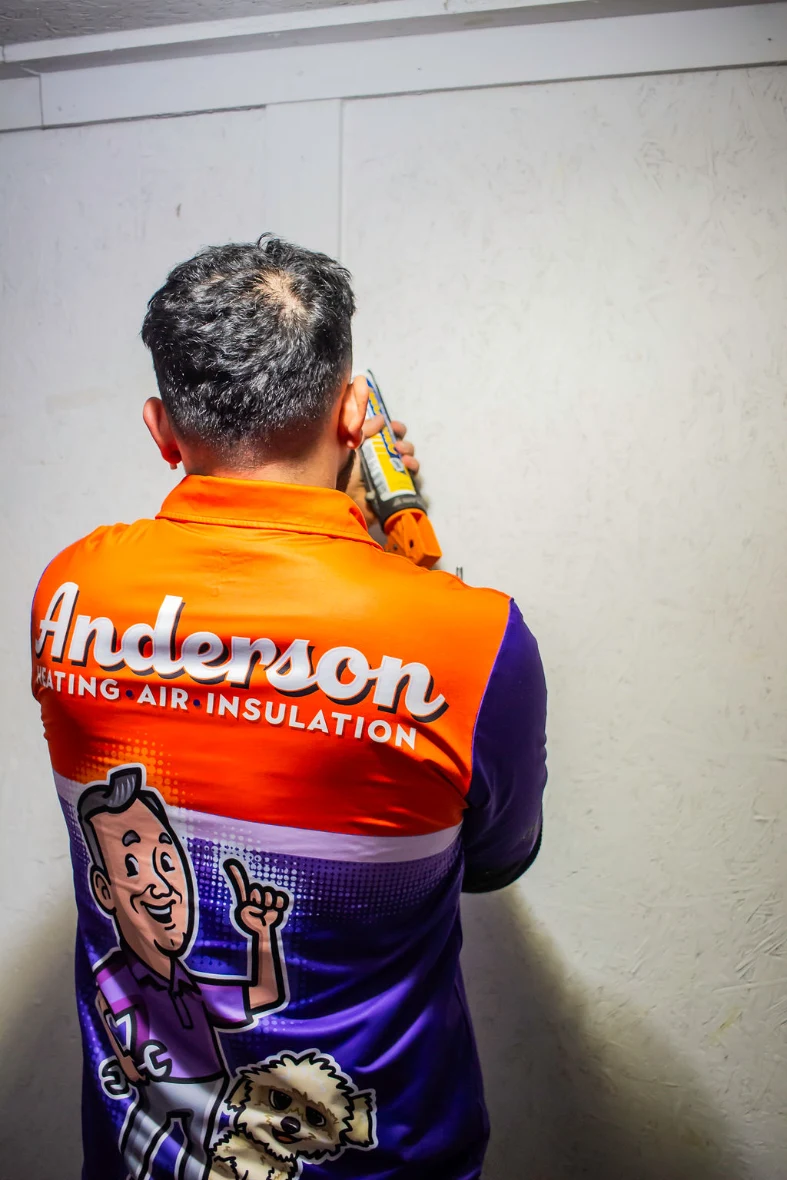
Anderson technician sealing air leaks along a wall with a sealant gun

The Short Answer

Spray foam insulation is sprayed in place as a liquid that expands and cures into foam, so it insulates and seals air leaks in one step. Anderson installs open-cell and closed-cell spray foam in attics and roof decks, crawl spaces, rim joists and accessible walls across Northwest Georgia. It isn’t the right answer for every home, so we assess the house first and recommend foam only where it fits.

The Problem

Is Your Home Losing Comfort Through the Building Envelope?

Gaps, thin insulation and uncontrolled air movement let heat in during summer and out during winter. The same symptoms can also come from ductwork, your HVAC system or moisture, so the cause is worth finding before choosing a fix.

  • Hot upstairs roomsBonus rooms and second floors that never cool down in summer.
  • Cold floorsFloors over a crawl space that stay cold all winter.
  • DraftsAir moving through gaps at rim joists, penetrations and attic openings.
  • High energy billsHeating and cooling running longer to keep up with leaks.
  • Humid crawl spacesDamp air under the house that can affect comfort above it.
  • Temperatures that are hard to controlRooms that swing hot and cold even with the system running.

Spray foam isn’t automatically the fix.

These symptoms can involve insulation, air sealing, ductwork, your HVAC system or moisture. We find out which ones apply to your home before recommending anything.

Where Spray Foam Can Go

Where Could Spray Foam Help Your Home?

Choose a part of the house to see how spray foam may be used there and why.

Cross-section of a house showing four places spray foam may be used: 1 attic roofline, 2 walls, 3 crawl space, 4 rim joists 1 2 3 4

Attic / Roofline

Spray foam may be applied to the underside of the roof deck in appropriate attic assemblies to help reduce air leakage and heat moving through the roof. It can bring the attic inside the home’s insulated space, which matters when ductwork or equipment runs through it.

Many vented attics are still best served by air sealing plus blown-in insulation on the attic floor, so we look at how your attic is built first.

Learn about attic insulation and air sealing

Walls

Open wall cavities, in additions, renovations and new construction, can be filled with spray foam to insulate and seal in one step. Finished walls usually call for a different method, because foam needs open access to the cavity.

See how an energy audit finds wall leaks

Crawl Space

In a crawl space, closed-cell foam is often considered for foundation walls, especially as part of sealing and conditioning the crawl space. Moisture comes first: drainage, vapor barriers and humidity control decide whether foam is the right step.

Learn about crawlspace encapsulation

Rim Joists / Floors

The rim joists around the edge of the floor framing are a common source of drafts. Spray foam fits the irregular framing, wires and pipes there, sealing and insulating spots that batts don’t fill well.

See air sealing and weatherization

Key Benefits

What Can Spray Foam Insulation Do?

  • Helps reduce air leakage

    Spray foam expands into cracks and gaps that can let air move in and out of the house.

  • Improves thermal protection

    Helps slow unwanted heat transfer through the areas it insulates.

  • Supports more consistent comfort

    A tighter, better-insulated envelope can help even out temperature differences between rooms.

  • Helps manage moisture movement

    Closed-cell foam resists water vapor at sufficient thickness. It is not waterproofing, and moisture problems still need their source addressed.

  • Reaches difficult areas

    Expanding foam conforms around irregular framing, pipes, wires and penetrations.

  • Works with the whole home

    Insulation, air sealing, HVAC, ventilation and moisture control all affect each other, so we plan them together.

Open-Cell vs. Closed-Cell

Which Spray Foam Is Right for Your Home?

There are two main types of spray foam. Neither is better everywhere; each suits different parts of a house.

Open-Cell Spray Foam Insulation

Lighter and softer, with more expansion

Structure
Soft, spongy foam whose cells are left open
Expansion
Expands a lot, filling large cavities
Air sealing
Seals air leaks when installed at the right thickness
R-value per inch
Lower: typically about R-3.5 to R-3.8
Water vapor
Lets water vapor pass through
Space needed
Needs more depth to reach the same R-value
Often considered for
Interior applications such as roof decks and walls, where its permeability suits the assembly

Closed-Cell Spray Foam Insulation

Denser and rigid, with more R-value per inch

Structure
Dense, rigid foam whose cells are closed
Expansion
Expands less and is applied in thinner passes
Air sealing
Seals air leaks when installed at the right thickness
R-value per inch
Higher: typically about R-6 to R-7
Water vapor
Acts as a vapor retarder at sufficient thickness
Space needed
Fits more R-value into tight spaces
Often considered for
Crawl spaces, rim joists and tight spots where moisture resistance or space matters

It Depends on Your Home.

The right foam, or whether foam is right at all, comes down to how your house is built and what you want to fix. We look at:

  • Installation location
  • Existing construction
  • Building assembly
  • Moisture conditions
  • HVAC design
  • Available space
  • Project goals

Where It Can Be Used

Spray Foam Solutions Throughout the Home

  • Attic Spray Foam Insulation

    Foam on the underside of the roof deck can help seal and insulate attics, especially ones that hold ductwork. We compare it with air sealing plus blown-in insulation first.

  • Crawl Space Spray Foam Insulation

    Foam on foundation walls can be part of sealing a crawl space, alongside moisture control and crawlspace encapsulation.

  • Wall Spray Foam Insulation

    Open wall cavities in additions, renovations and new construction can be insulated and sealed in one step.

  • Rim Joists & Hard-to-Seal Areas

    Rim joists, penetrations and irregular framing are where foam’s ability to fill gaps pays off.

Spray Foam vs. Traditional Insulation

Is Spray Foam Better Than Fiberglass or Blown-In Insulation?

Not automatically. The right insulation depends on the home’s construction, existing insulation, attic and crawl space conditions, moisture, budget, HVAC system and the area being insulated.

Spray Foam

Insulates and air seals in one step

Strengths
Seals gaps as it insulates; fits irregular spaces; closed-cell adds high R-value per inch
Limitations
Higher upfront cost; occupants stay out during installation; harder to change later
Often a good fit for
Rim joists, crawl space walls, roof decks and open cavities where sealing matters

Blown-In Insulation

Loose-fill cellulose or fiberglass

Strengths
Cost-effective way to build up attic floor insulation; fills around obstacles
Limitations
Doesn’t stop air leaks on its own, so it pairs with air sealing; some types settle over time
Often a good fit for
Vented attics after the attic floor is air sealed

Fiberglass Batts

Pre-cut blankets between framing

Strengths
Lower material cost; familiar for open walls and new construction
Limitations
Doesn’t stop air leaks; gaps and compression reduce how well it performs
Often a good fit for
Accessible wall cavities and floors where the fit can be done well

Not sure what your home actually needs?

Anderson evaluates the home and recommends an insulation strategy, rather than starting from one material. Sometimes that’s spray foam; often it’s air sealing and blown-in insulation, or a mix.

The Anderson Difference

Insulation Doesn’t Work Alone.

Changing the building envelope changes how the rest of the house behaves. Sealing and insulating can affect heating and cooling loads, humidity, ventilation and how your HVAC system runs. That is why Anderson looks at how these systems work together instead of treating insulation as a stand-alone product.

As a BPI-certified contractor that also services and installs heating and cooling equipment, we can look at insulation and air sealing, your HVAC system and crawl space moisture in the same visit, and tell you what will make the biggest difference.

When spray foam is the right call

Spray foam earns its place where sealing and insulating have to happen together: rim joists, crawl space walls, roof decks over ductwork and open cavities in additions. Where a simpler approach will do the job, we’ll tell you.

How It Fits Together

Your Home Works as One System

Your Home

Change one part and the others respond.

  • InsulationSlows heat moving through attics, walls and floors.
  • Air sealingStops air leaking through gaps and cracks.
  • HVACHeats and cools the air, sized to the house.
  • VentilationBrings in fresh air on purpose, not through leaks.
  • Moisture managementKeeps humidity and dampness under control.

Comfort and efficiency come from these parts working together. Learn more about HVAC repair & installation and indoor air quality and humidity.

Our Process

What to Expect From Spray Foam Installation

  1. Home assessment

    We look at the area you’re considering, how it’s built, the existing insulation, any moisture concerns and the comfort problems you’ve noticed.

  2. Recommendation

    We tell you whether spray foam makes sense, which type and where, or whether another approach fits better.

  3. Preparation

    We prepare and protect the work area before any foam is applied.

  4. Professional installation

    Our crew installs the specified foam according to the project’s requirements.

  5. Final review

    We review the completed work and the project details with you.

What Happens During Installation?

Knowing what the day looks like takes the guesswork out of it.

  1. Before

    • Inspection of the area
    • Project preparation
    • Protection of surrounding areas
  2. During

    • Professional application
    • A controlled work area
    • Installation according to project requirements
  3. After

    • Inspection of the work
    • Cleanup
    • Project review with you

Occupancy and re-entry requirements depend on the product used. We go over them with you before the work is scheduled.

Local Experience

Spray Foam Insulation for North Georgia Homes

We work on homes across Calhoun, Dalton, Rome, Cartersville, Adairsville and the surrounding communities, and the house itself shapes the right approach.

  • Older in-town homes

    Existing insulation, additions and air leakage need a careful look before choosing where foam belongs.

  • Brick ranches

    Attic and crawl space conditions often drive comfort, so those two areas get attention first.

  • Newer subdivisions

    Targeted insulation or air sealing, such as bonus rooms or rim joists, can fix specific problem areas.

  • Farmhouses & rural homes

    Older construction, additions, crawl spaces and irregular framing can create unique insulation challenges.

Reviews

What Anderson Customers Say

Rated 4.8 across 670+ Google reviews from Northwest Georgia homeowners.

  • Google review

    ★★★★★

    “Exceptional Service from Start to Finish. The team at Anderson Heating and Air provided outstanding service from beginning to end...”
    Cheryl Collins
    Rome, GA
  • Google review

    ★★★★★

    “I recently had the pleasure of experiencing exceptional service from Josh, Joe, and Eddie. From the moment they arrived, their professionalism and dedication were evident...”
    Tamara Garwood
    Rome, GA
  • Google review

    ★★★★★

    “Josh and Keith did a fantastic job with my air conditioner. Very professional, knowledgeable about what they were doing...”
    Gloria Leonard
    Adairsville, GA

Read more reviews

FAQ

Spray Foam Insulation FAQ

How does spray foam insulation work?

Two liquid components are mixed and sprayed onto a surface, where they expand and cure into foam. The foam fills cracks and gaps as it expands, so it insulates and helps seal air leaks at the same time.

What’s the difference between open-cell and closed-cell spray foam?

Open-cell foam is lighter, softer and expands more, and it lets water vapor pass through. Closed-cell foam is denser and rigid, has a higher R-value per inch and acts as a vapor retarder at sufficient thickness. Each suits different parts of a house.

How much does spray foam insulation cost?

It depends on the area being insulated, the type and thickness of foam, access to the space, any prep or removal needed and the size of the project. Spray foam usually costs more upfront than blown-in or batt insulation. We give you the price for your home after an assessment, before any work begins.

Is spray foam good for attics?

It can be, especially when ductwork or equipment sits in the attic or the roof assembly suits it. Many vented attics are still best served by air sealing plus blown-in insulation on the attic floor. We look at how your attic is built before recommending either.

Can spray foam be used in crawl spaces?

Yes. Closed-cell foam is often used on crawl space foundation walls and rim joists. Moisture needs to be handled first, so it is usually planned together with vapor barriers, drainage or crawlspace encapsulation.

Can spray foam be installed over existing insulation?

Usually not directly. Foam needs to bond to a clean surface, so existing batts or loose-fill in the way generally have to be moved or removed in the areas being foamed. Whether that is worth it depends on the condition of what’s there.

Does old insulation need to be removed first?

In the areas where foam will be applied, usually yes. Damaged, wet or contaminated insulation should come out either way. We’ll tell you what needs to be removed for your project.

How long does spray foam installation take?

It depends on the size and number of areas. Many residential projects take a day or two of work, but we’ll give you a timeline for your project when we plan it.

Can I stay home during spray foam installation?

Occupants are generally kept out of the work area during spraying and for a period afterward. The specific requirements depend on the product, so we’ll explain what applies to your project before the work is scheduled.

Does spray foam help reduce air leakage?

Yes. Installed at the right thickness, both open-cell and closed-cell foam help seal the gaps and cracks they cover. Leaks elsewhere in the house still need to be found and sealed separately.

How long does spray foam insulation last?

Spray foam is a long-lasting material that doesn’t settle the way loose-fill insulation can. How long it performs depends on proper installation and on keeping moisture and other problems away from it.

Is spray foam right for older North Georgia homes?

Sometimes. Older homes often have additions, crawl spaces and irregular framing where foam works well, but they can also have moisture, wiring or ventilation issues that need attention first. An assessment tells you whether foam fits.

Can spray foam affect my HVAC system?

Yes. A tighter, better-insulated house needs less heating and cooling and can change humidity and ventilation needs. That can affect how your system runs and what size makes sense when it’s replaced. Because we work on both insulation and HVAC, we plan for that together.

Ready for a More Comfortable Home?

Not Sure If Spray Foam Is Right for Your Home?

You don’t have to figure it out yourself. Anderson Heating, Air & Insulation can evaluate your home and help determine which insulation approach makes sense for your comfort, efficiency and building needs.

Takes less than 30 seconds!

Request Service

Tell us what's going on and we'll take care of the rest.

Your information is secure and never shared.

Call Now: (706) 629-0749